

Clinician Emotional
Resources Training
is an experiential learning program
created to train clinicians to access and develop
their underlying emotional resources
in order to enhance their effectiveness with their patients and achieve a greater sense of fulfillment in their professional relationships and careers.
Professional Training
Innovative & Novel
Trainings are innovative because they focus on physiology and neurobiology rather than psychology and psychological approaches. These innovative trainings cleverly and practically activate and differentiate a wide range nonconscious clinician emotional resources. The actual training process works directly with obligatory physiological responses to the interventions and exercises. These physiological responses can be empirically observed and guide the training process. The training process does not depend on cognitions or understanding. The participants are able to learn how to harness the energy of their own emotional resources and their concomitant physiology.
Training exercises are novel because they focus on highly evolved emotional brain systems that are out of awareness and hidden in plain sight. Traditional clinician trainings have no access to 80% of clinicians’ emotional resources. Most of these emotional resources develop preverbally and nonverbally during infancy. Examples of such emotional resources are the Safe, Care and Connection brain systems each of which develop independently and simultaneously in the first few months of life.
Challenges
Benefits are immediate and empirically physiologically observable within every training session.
Clinicians are intimately engaged in the sessions and thus everyone in the sessions benefit, including the trainers. Short and long-term outcomes have revealed that the clinicians develop better internal emotional balance, greater capacity to develop healing relationships, more fulfilling careers, more creativity and resilience in their work. Clinician Emotional Resources Training stands on the foundations of universal highly evolved human neurobiology. These foundations enable the process to be consistently effective with each and any specific group of clinicians. See testimonials
The trainers have learned how to trust and work with the presence of the 21 inherent emotional resources of all clinicians in the room. The trainers know that these systems will naturally respond to focused stimulation just like any other reflex.
Benefits & Outcomes
This type of training invites all the participants to be naturally intimate with their own emotions. Many clinicians are, however, uncomfortable with fully experiencing their emotions. They unknowingly stay within their familiar, comfort zones.
Consequently, the clinicians are unaware of the many emotional resources hidden inside them and thus are unable to reach their full potential. They are often afraid to deal with their underlying fear, grief, and shame. The in-person group settings and the innovative nature of the training process readily reduce the clinicians’ natural ambivalence, fears, or skepticism.
Clinician Emotional Resources
What “clinician emotional resources” are we referring to?
Traditional perspectives on clinician emotional resources refer to: therapeutic alliance, empathy, goal consensus, collaboration, and positive regard,. Those are actually all emotional skills. In contrast, these learning programs are designed to train the many underlying radical emotional resources that have evolved over 100,000 years. The precise term, radical, specifically refers to something fundamental, goes to the root of an issue and is a drastic departure from tradition. These emotional resources are capabilities and competencies that are at the roots of all of our emotional skills. For example, many distinct radical emotional resources evolved to facilitate profound human capabilities such as maternal care, pair bonding, and social cohesion. Inherent emotional resources are primarily nonconscious and located much deeper in the nervous system than emotional skills.
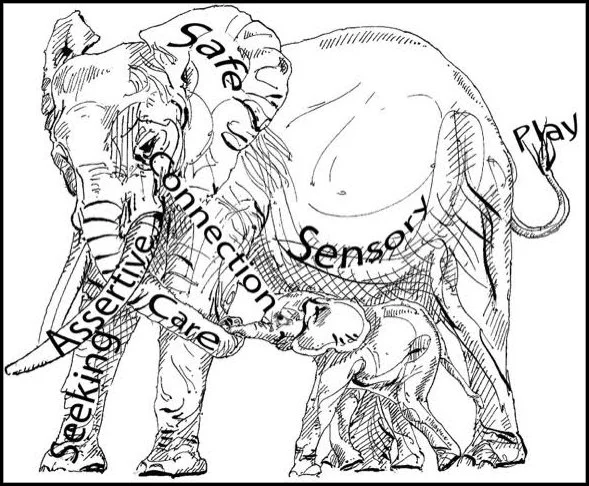
The elephant is intended to illustrate the fundamental brainstem emotional resources that are present in all mammals. The illustration also shows how the mother’s care for the infant develops these emotional resources instinctively in both mother and child.
What Does The
Training Look Like?
Request an Assessment
Submit project parameters, and a consultant will respond promptly to discuss objectives, timelines, and recommended next steps.
-
“The human honesty of both trainers was inspiring. To see such experienced clinicians to be kind, real, connected says a great deal. They embody in real life what we are trying to learn.”
— Training Participant
-
"The trainers are open and humble and inspired and inspiring and growing.”
— Training Participant
-
“Clinician Emotional Resources Training is helping our world grow more kind, compassionate and aware."
— Training Participant
-
“Thank you for your own passion and vulnerability with us.”
— Training Participant